 08045815886


 Send Inquiry
ConXport PORTABLE SEMEN ANALYSIS MICROSCOPE
ConXport PORTABLE SEMEN ANALYSIS MICROSCOPE Specification
- Focus System
- Coarse and fine focus knob system.
- Spare Parts
- Eyepiece, objective lens, power cable, USB cable.
- Features
- Portable, lightweight design, digital output, easy to operate, suitable for field and lab use.
- View Head
- Monocular, rotatable.
- Theory
- Portable semen analysis using advanced digital imaging for microscopic study.
- Drawtube
- Monocular Drawtube.
- Sensor
- CMOS Digital Imaging Sensor.
- Resolution
- High-resolution digital output, up to 640 x 480 pixels.
- Interface
- USB connectivity for PC/Laptop interface.
- Frame Rate
- Up to 30 fps digital streaming.
- Focal Distance
- Adjustable focal distance depending on magnification.
- Magnification
- 100x, 400x, 1000x (with provided objective lenses).
- Dimensions
- Approx. 30 cm (H) x 20 cm (W) x 15 cm (D).
- Focus Range
- Coarse and fine focusing available.
- Eyepieces
- Standard WF10x eyepiece.
- Eyepiece Tube
- Straight tube for comfortable viewing.
- Illumination
- LED illumination with intensity adjustment.
- Coarse Adjustment Range
- Throughout the working range.
- Fine Adjustment Range
- Micro-level fine focusing adjustment.
- Working Stage
- Mechanical stage with slide holder and knobs for X-Y movement.
- Still Image Capture Resolution
- 640 x 480 pixels.
- Video Capture Resolution
- 640 x 480 pixels at 30 fps.
- Image Format
- JPG, BMP, PNG supported by bundled software.
- Interpupillary Distance
- Fixed for monocular tube.
- Objective Achromatic
- Achromatic objectives 10x, 40x, 100x.
- Condenser
- Abbe condenser NA 1.25 with iris diaphragm.
- Light Source
- LED lamp, rechargeable battery included.
- Usage
- Suitable for laboratory and mobile clinical applications
- Color
- White/black combination
- Net Weight
- Approx. 2.5 kg
- Body Material
- Durable ABS plastic and aluminum alloy
- Sample Capacity
- Standard glass slides up to 75 x 25 mm
- Data Output
- USB 2.0 connectivity
- Software Included
- Image analysis and measurement software
- Carrying Case
- Hard carrying case included for portability
- Operating System Compatibility
- Compatible with Windows and Mac OS
- Immersion Oil
- Provided for 40x(S) objective
- Working Temperature
- 5C to 40C
- Power Supply
- Rechargeable battery (Li-ion) or direct AC adapter
- Stage Dimensions
- 120 x 120 mm
ConXport PORTABLE SEMEN ANALYSIS MICROSCOPE Trade Information
- FOB Port
- Delhi
- Payment Terms
- Paypal, Letter of Credit (L/C), Telegraphic Transfer (T/T)
- Supply Ability
- 15 Per Week
- Delivery Time
- 6-7 Days
- Sample Available
- Yes
- Sample Policy
- If order is confirmed we will reimburse the sample cost
- Main Export Market(s)
- Australia, South America, Eastern Europe, Western Europe, Middle East, Asia, Central America, North America, Africa
- Main Domestic Market
- All India
- Certifications
- ISO,CE,FDA,WHO-GMP
ConXport PORTABLE SEMEN ANALYSIS MICROSCOPE About
Description
DigitalPID Bio-Thermal hot plate is one of the best microscope for viewing transparentor translucent specimens without a loss of resolution. This technique hasproven to be a valuable tool for medical researchers in the study of livingcells, cultures and many applications. The PROPORTIONAL -INTEGRAL- DERIVATIVECONTROLLER (PID controller) is a generic control loop feedback mechanism (controller)which is widely used in medical control systems. This device is mainly used inAnimal husbandry, various governmental & private Semen banks. This deviceis used to retain the plate at a proper temperature to check the live semensunder the phase contrast light.
SPECIFICATIONS of BinocularPathological Research Microscope:
| Optical System: | Plan / Achromatic optical system. |
| Magnification: | 100x-1000x for visual observation. |
| Eyepiece tubes: | Monocular tube |
| Eyepieces: | WF 10x (F.O.V. 20mm) & Centering telescopic eye-piece. |
| Nosepiece: | Quadruple nosepiece, reversed type. |
| Stage: | Rectangular142x 120 mm surface stage mounted on the main body cross travel 130x50mm using low-positioned X/Y coaxial control knob. |
| Objectives: | Phase Plan / Achromat10x N.A.0.25, 20x N.A.0.4, 40x N.A.0.65,100x N.A.1.25 |
| Condenser: | Phase contrast condenser, Annular diaphragm turn plate. |
| Illumination: | 3W LED lighting system with brightness controller. |
| Filters: | Frosted White Filter & Green Filter. Digital PID Bio-Thermal Hot Plate. |
| Control Action: | PID Reverse Action |
| Input: | K type thermocouple. |
| Output: | Relay Output. |
| Alarm: | 1 deviation High alarm (AL1) |
| Temperature Range: | Room Temperature 100 Celsius with auto cut facility. |
Advanced Digital Imaging for Accurate Results
With a CMOS digital imaging sensor and bundled software, the ConXport microscope delivers high-resolution still images and video (640 x 480 pixels at 30 fps). The USB 2.0 interface ensures streamlined transfer of images and measurements, making data analysis straightforward and efficient for both laboratory technicians and mobile clinicians.
Portable Design with Versatile Power Sources
Engineered for field use as well as laboratory settings, this microscope weighs just 2.5 kg and comes with a hard carrying case. Its dual power supplyrechargeable Li-ion battery and direct AC adaptersupports uninterrupted operation, whether in remote locations or dedicated labs.
User-Friendly Operation and Comprehensive Accessories
From standard WF10x eyepieces to mechanical X-Y stage controls, the microscope is designed for ease of use. Coarse and fine focusing knobs, LED illumination with intensity control, and included spare parts (eyepiece, objective lens, cables, immersion oil) ensure accurate observations and long-term reliability.
FAQs of ConXport PORTABLE SEMEN ANALYSIS MICROSCOPE:
Q: How does the ConXport Portable Semen Analysis Microscope streamline semen analysis in clinical or field settings?
A: This microscope integrates advanced digital imaging with portable design, enabling quick microscopic evaluation of semen samples both in laboratories and on-site. The included analysis software allows for immediate measurement and image capture, streamlining the diagnostic process.Q: What steps should I follow to operate and capture images using this microscope?
A: Simply place a standard glass slide (up to 75 x 25 mm) on the mechanical stage, use the coarse and fine focus knobs to clarify the sample, and utilize the provided software to capture still images or video via the USB 2.0 interface. Adjust LED illumination as needed for optimal clarity.Q: When should I choose battery versus AC adapter power supply for use?
A: Select the rechargeable battery option when conducting fieldwork or when access to electrical outlets is limited. Use the included AC adapter for uninterrupted operation in laboratory environments or when conducting prolonged analyses.Q: Where is this microscope best utilized?
A: It is ideal for laboratories, mobile clinics, or any remote diagnostic setting that requires high-quality semen analysis. Its lightweight, hard-cased portability makes it suitable for veterinarians, researchers, and clinicians working in diverse locations.Q: What benefits does the image analysis software provide?
A: The integrated software supports real-time observation, measurement, and digital archiving of sample images in various formats (JPG, BMP, PNG). It enhances diagnostic accuracy while simplifying sample documentation and report generation.Q: How is immersion oil used with this microscope for semen analysis?
A: The provided immersion oil is applied when using the 40x(S) objective lens. This improves image resolution and clarity at higher magnifications by minimizing light refraction between the lens and the glass slide.Q: What factors ensure the durability and reliability of the ConXport Portable Microscope?
A: Constructed with durable ABS plastic and aluminum alloy, the microscope resists wear during transport or regular use. The hard carrying case, spare accessories, and robust focusing and illumination systems contribute to long-term, reliable performance.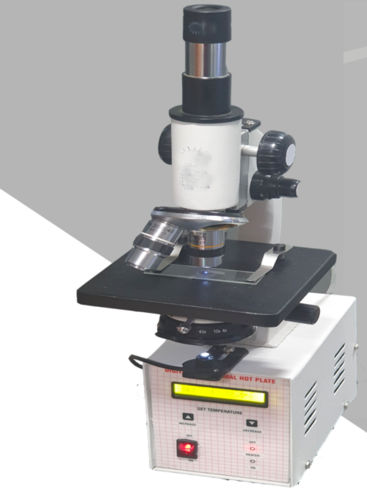
Tell us about your requirement

Price:
Quantity
Select Unit
- 50
- 100
- 200
- 250
- 500
- 1000+
Additional detail
Mobile number
Email

More Products in Microscopes And Projector Category
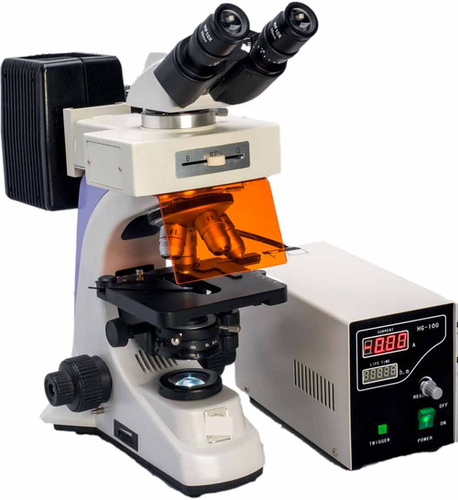
ConXport . Fluorescent Research Microscope
Eyepieces : Wide field 10X/18mm, paired set
Fine Adjustment Range : 0.002 mm per division
Illumination : LED lamp for transmitted light, 100 W highpressure mercury lamp for fluorescence
View Head : Trinocular, 45 inclined and 360 rotatable, suitable for photomicrography
Eyepiece Tube : Trinocular head with diopter adjustment on one side
Interpupillary Distance : 5575 mm adjustable
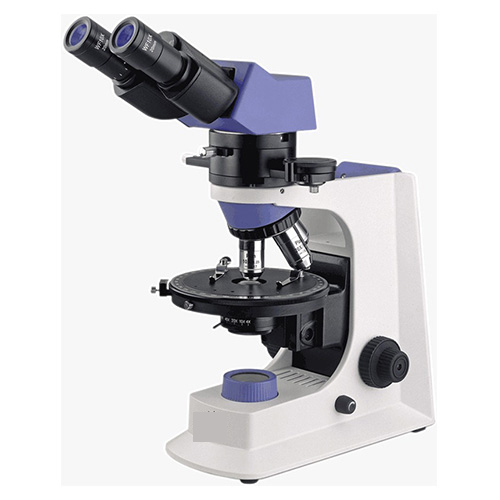
ConXport Upright Polarizing Microscope PQR-500S
Eyepieces : Wide Field 10x/18mm Pair with cross hair & pointer (high eyepoint); optional 16x available.
Fine Adjustment Range : Minimum reading 0.002 mm.
Illumination : Transmitted Kohler illumination, halogen lamp 6V/20W (replaceable) with adjustable intensity.
View Head : Trinocular, 360 rotatable, inclined at 30.
Eyepiece Tube : Inclined at 30, 360 rotatable trinocular head.
Interpupillary Distance : 5375 mm adjustable.
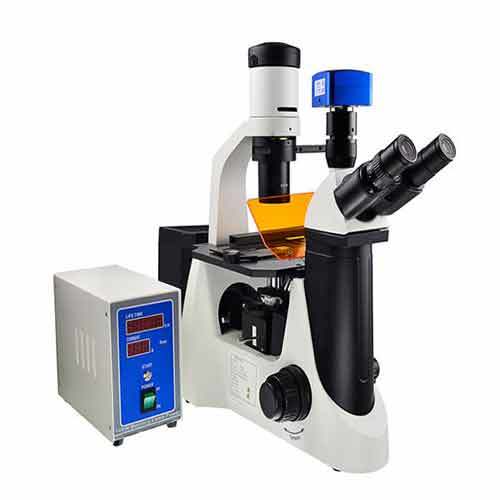
ConXport . Fluorescent Research Microscope
Eyepieces : Wide field 10x/22mm paired eyepieces.
Fine Adjustment Range : 0.002 mm
Illumination : LED or Mercury vapor fluorescent light source with adjustable intensity.
View Head : Trinocular, 30 inclined, rotatable 360.
Eyepiece Tube : Trinocular tube for simultaneous eyepiece viewing and camera mounting.
Interpupillary Distance : 55 75 mm adjustable.
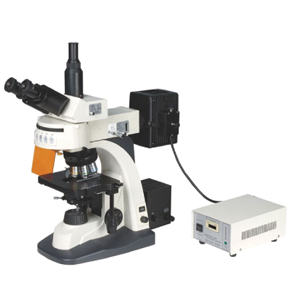
ConXport Fluorescent Research Microscope
Eyepieces : WF 10x/18 mm paired (with diopter adjustment on one eyepiece)
Fine Adjustment Range : 0.002 mm per division
Illumination : LED Fluorescent epiilluminator (Mercury lamp optional/available), with transmitted LED illumination for bright field observation
View Head : Trinocular Siedentopf head, 360 rotatable, inclined at 30
Eyepiece Tube : Trinocular, inclined at 30
Interpupillary Distance : 5075 mm (adjustable)

 Send Inquiry
 Send SMS
 Call Me Free
|


CONTEMPORARY EXPORT INDUSTRY
GST : 06AJMPT4011D1ZG
GST : 06AJMPT4011D1ZG

- B No. 4353, Main Road, Near Geeta Gopal Temple,Ambala Cantt - 133001, Haryana, India
- Phone :08045815886

- Mr Akhil Trehan (Proprietor)
- Mobile :08045815886
- Send Inquiry
 Send Inquiry
CONTEMPORARY EXPORT INDUSTRY
All Rights Reserved.(Terms of Use)
Developed and Managed by Infocom Network Private Limited.
Developed and Managed by Infocom Network Private Limited.

